
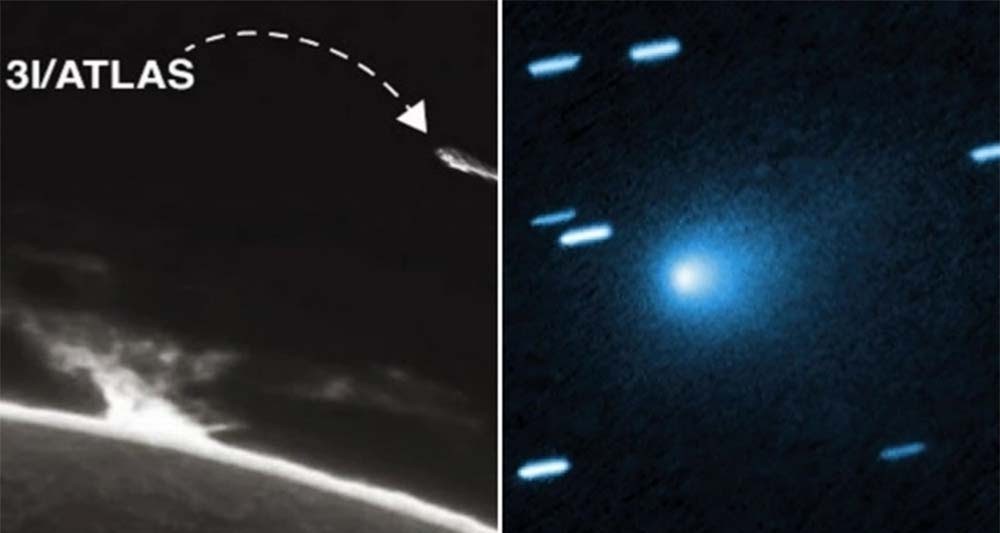

Perspektif.co.id - The National Aeronautics and Space Administration (NASA) has confirmed the discovery of an extraordinary interstellar object named 3I/ATLAS, marking only the third known visitor from beyond our solar system.
The newly identified comet was first detected on July 1, 2025, by the Asteroid Terrestrial-impact Last Alert System (ATLAS) telescope based in Rio Hurtado, Chile. Astronomers quickly noted its unusual hyperbolic trajectory, a key indicator that the object originated outside our solar system and is not bound by the Sun’s gravity.
“3I/ATLAS represents the third confirmed interstellar object observed entering and exiting our solar neighborhood,” NASA explained in an official statement. “Its orbital path clearly shows it came from another stellar system and will not return once it departs.”
Earlier discoveries of similar nature include ʻOumuamua (1I/2017) and 2I/Borisov (2019). Both sparked intense debate among astronomers regarding their origins and composition. The arrival of 3I/ATLAS now provides a new opportunity for scientists to study material that formed in another part of the galaxy.
According to NASA’s latest calculations, the comet is currently about 670 million kilometers from Earth, traveling at approximately 61 kilometers per second (221,000 kilometers per hour). Its closest approach to Earth will be around 1.8 astronomical units (270 million kilometers), posing no threat whatsoever to our planet.
The object is expected to reach perihelion, its nearest point to the Sun, on October 30, 2025, at a distance of about 1.4 astronomical units (210 million kilometers) slightly inside the orbit of Mars.
“This is a rare chance to examine pristine material from beyond our solar system,” said one NASA researcher involved in the observation campaign. “Studying 3I/ATLAS can reveal valuable clues about how other planetary systems formed.”
Global observatories and research institutions are now coordinating to monitor the comet’s movement and composition. Scientists hope the data collected will deepen understanding of interstellar objects and their role in shaping cosmic evolution.